
Battery recycling technologies
The production of lithium-ion batteries is a growing market. But the more lithium-ion batteries are produced, the more batteries will have to be recycled. Battery manufacturers are dealing with two different types of recycling:
It is estimated that in the EU alone, there will be around 325.000 tons of available battery scrap in 2030. Among this scrap, there are valuable and critical raw materials like manganese, cobalt, lithium compounds or graphite. These can now be reintroduced into the production cycle, thus making the production of lithium-ion batteries much more efficient.
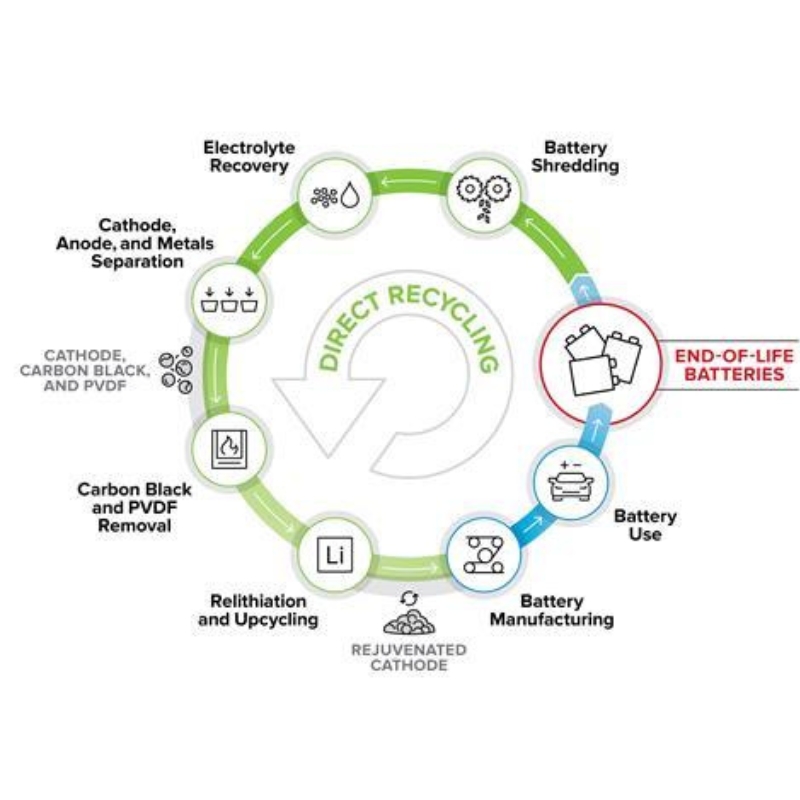
The quantity and quality of the recovered material depends on the choice of lithium battery recycling technology. With ON’s battery recycling solutions, you can be sure that you lose very little valuable material, making your battery production process as efficient as possible. For this purpose, ON provides you with various lithium battery recycling machines and systems, developed and configured for your specific requirements.
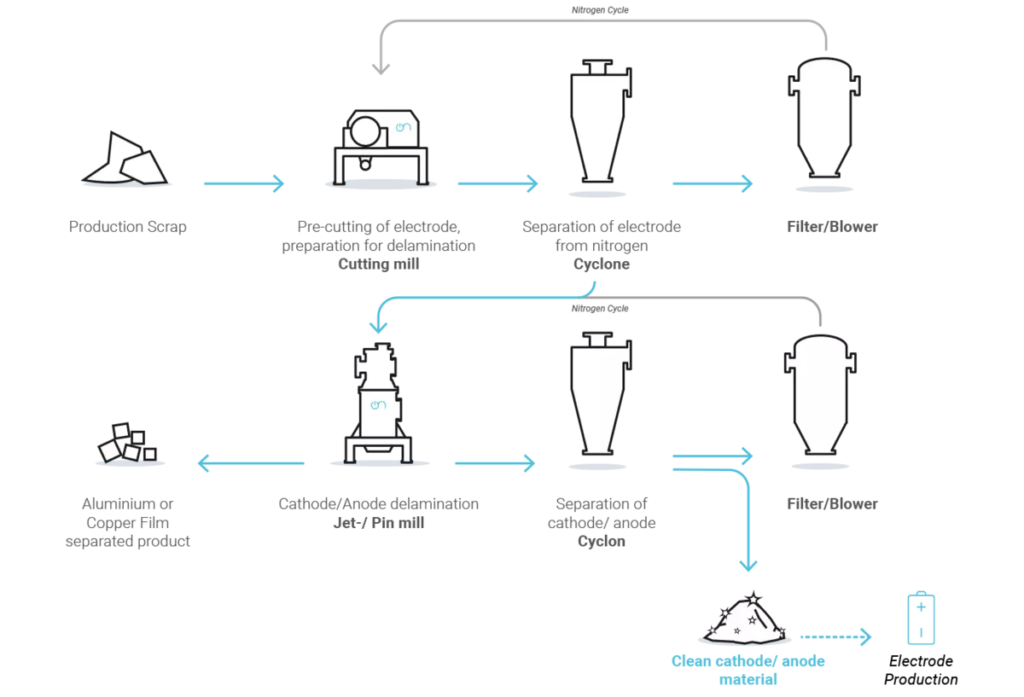
Hosokawa Micron offers innovative solutions for direct recycling of production scrap during the battery production process. Here, our system takes the production scrap, cuts the foil into small pieces and delaminates the cathode or anode material to send it directly back to the coating process
Direct scrap recycling of lithium-ion batteries
During the production process of lithium-ion batteries, there is a lot of production waste. This occurs mainly during the coating process, for example, when sorting out defects such as pinholes, inclusions and other coating faults, due to edge trimming or rejects during the finishing process. In total, about 10% (or considerably more depending on the process) of the coated cathode or anode foils end up as rejects and have to be recycled. This is a problem when it concerns the valuable active materials, i.e. the NMC or LFP of the cathode foils or the graphite-silicon mixtures of the anode foils. Currently, this foil scrap is collected from battery manufacturers by 3rd party recycling companies. ON has developed a new process for direct scrap recycling of production scrap where the scrap can be recycled at the production site and fed directly back into the production cycle. This makes production more efficient, and the cathode and anode material scrap can be almost completely recycled without impurities and be reintroduced into the coating process. Customers also save themselves the effort involved in external recycling.
Direct recycling of the active materials
ON’s process of direct recycling during the electrode production: one process can be applied to both anode or cathode material. However, separate production lines are necessary to recycle anode and cathode material.
Test centre for battery recycling solutions
To help you choose the most suitable battery recycling technology, detailed trials can be conducted using your electrode foils at advanced test facilities. Together, the recycling process is validated through feasibility tests as well as scale-up trials, ensuring the selected lithium battery recycling solution matches your product specifications and operational requirements.
From the first quarter of 2025, a dedicated test centre will also be available for direct scrap recycling trials during live battery production. These trials evaluate how the recycling process integrates with your existing production line, improves efficiency, and supports compliance with required recycling targets. All tests are carried out using high-performance recycling machinery under strict safety standards to protect both personnel and operations.
End-of-life: Battery Black Mass recycling
When a battery reaches the end of its life, the raw materials it contains can be recycled. This end-of-life recycling is an environmentally sustainable and economically viable battery recycling technology, as it reduces the need for new raw materials.
After collection, the battery is dismantled, shredded and processed to produce the “black mass”. The black mass of the anode contains high amounts of graphite, whereas the black mass of the cathode consists of lithium, manganese, cobalt and nickel. End-of-life recycling extracts these valuable materials from the black mass so they can be re-used in the production of new batteries.